I have been developing a film related podcast project called Breaking Cinema that has been having some teething problems.
Primary among these problems is a lack of a clarity in regards to the specific focus of the podcast project and it is for this reason that I have not until now detailed the Breaking Cinema podcast on this blog.
However, the project now has a focus that is becoming clearer by the day!
A rough approximation of what the eventual logo will look like. Probably.
For the longest time, the best description I could provide to the other project members was that...
"This podcast is not just about films."
Essentially what I have been trying to say with this statement is that the focus of Breaking Cinema aligns itself with what I was gunning for in my award-winning undergraduate theoretical dissertation, Ways of Being: The Spectator and the Spectacle, and my continuing transdisciplinary research project, Ways 2 Interface.
And that focus was concerned with moving the study of cinema beyond textual critical analysis of two-dimensional images on a screen and placing greater transdisciplinary emphasis on the wider and empirical implications of the spectator's involvement and human culture as a whole.
"The fundamental focus of the project is the idea of an interfacing process - the introspective and expressive capacity inherent to us all - that we have always interwoven throughout our day-to-day existences and that we continue to do so at a formidably greater capacity in our contemporary digital realities. By examining the habits and manifestations of our cognitive, corporeal, cultural and connected ways to interface, 'Ways 2 Interface' will aim to build a unified understanding of this interfacing process - the brand at the heart of all our stories."
Now, after nearly a year of actively working away on this project and recording various test episodes, I am now in a position where I can say that I very nearly have the project's focus and format fully figured out. Finally!
And this epiphany was in great part assisted by the following spontaneous forty-minute reflection I produced while I had a touch of the flu and was in a hugely lucid state of mind...
Breaking Cinema with a Selfie Stick, A Flu-Induced Reflection by Peter O'Brien
Sometimes all you need is a bit of flu! More coming soon.
I have produced another microfilm using Vimeo's Cameo app on my iPod Touch based around my three days at the Encounters Short Film and Animation Festival in Bristol.
This microfilm is more of just a collected of clips opposed to a micro narrative because I just did not have the energy to capture nearly as much footage I would have liked at Encounters. However, I did enjoy being a spectator of the festival.
I have now completed TCM Presents Into the Darkness: Investigating Film Noir, a free online multimedia course from Ball State University as offered on the Canvas Network and, through the course of becoming a bit tougher and wiser, I now possess a vastly greater understanding and appreciation of the film noir movement.
My Certificate of Completion.
The film noir movement is an area of film that I have always struggled to find a way into; that is not to say that I have not seen any film noir films, I have seen plenty, but studying the progression and intricacies of the movement has always been a challenge.
Unfortunately, I was unable to undertake the film noir module, Film Noir: The Dark side of the Screen, as part of my second year BA (hons) Film and Screen Studies because I did not have enough credit to do so. Although, in hindsight, I should have just asked if I could have sat in on the lectures, my tutors would not have said no.
However, Investigating Film Noir has more than made up for this missed opportunity and I get the impression from the full spectrum of this online course that it equals the full breadth of The Dark Side of the Screen module at Bath Spa University.
One of the common criticisms of online courses or MOOCs (Massive Open Online Courses) is that they can not compare to a real-world paid course.
Okay, let's investigate this assumption a little more.
I did not take The Dark Side of the Screen module at university, but I know for a fact from other students who did take it and from the formats of the other modules I myself took that the The Dark Side of the Screen module would have been comprised of:
Lectures - in which the tutor (Suman, bless his heart) would have gradually taken the class through the film noir movement; as complimented by...
Seminars - in which film screenings, readings and active class discussion would have further delved into the complexities of the film noir movement.
Now, as it stands with Investigating Film Noir, I have just undertaken an online course in which I had to
digest a series of weekly video lectures that gradually peeled back the layers of the film noir movement
view a program of film noir screenings on TCM (I don't have TCM, so I made do with what I could find online)
examine various primary and secondary readings of the subject
take part in the many discussion forums of the course with the other students.
Therefore, I feel that this online offering, in collaboration with TCM, serves as a formidable example of the potential of online learning in regards to the discipline of Film Studies, a discipline that could very easily be taught online, as indeed it kind of already is...
Out of the Past - Film Studies 2.0
Out of the Past: Investigating Film Noir is the first Film Studies podcast that debuted online and it serves as the basis for this MOOC, as it was created by Dr Richard L. Edwards, the co-host of Out of the Past.
I have not listened to all of the Out of the Past episodes, but I sure if I had I would possess a greater understanding of film noir movement and all of the films therein. However, it is clear to see from the episodes I have listened to and from looking through its back-catalogue of episodes that the Out of the Past podcast offers a very comprehensive overview of the film noir movement and it is not at all surprising that TCM approached Dr Edwards to create the Investigating Film Noir MOOC spin-off.
In the most recent episode of Out of the Past - Noircast Special 4: TCM Presents Into the Darkness: Investigating Film Noir - Edwards and company discuss the inception, creation, outreach and potential of the Investigating Film Noir MOOC; it certainly makes for an interesting listen and seems to point towards a desire for there to be many more offerings such as Investigating Film Noir.
I would most certainly be behind any future online Film Studies offerings because that is where I believe the discipline will gain a whole new lease of life, opposed to just repeating itself, over and over again!
Below is my video review of the Investigating Film Noir MOOC...
Exactly what I already knew, for such a prolific film movement, film noir is also an oddly illusive entity.
Getting your head around the whole film noir movement was not nearly as hard as I thought it would be, you just have to think of these films as being representative of the full range of the human psyche - not nearly as warm and cosy as we like to believe.
In a recent film noir episode that was recorded for my Breaking Cinema podcast I lamented that the essence of what makes a film noir film a film noir film has become so saturated and absorbed by other filmmakers that you can identify film noir elements in the majority of all the films of modern cinema.
Obviously, we have the neo noir which is our contemporary equivalent of a film that leans more strongly towards the conventions of a traditional film noir, but even so, the neo noir conventions can still be found in the majority of all the films of modern cinema precisely because they make up the majority of the films of modern cinema. After 9/11 there was an insistent transition towards darker and grittier cinema and this is a maturity of cinema that will never fully go away, as was the case with the emergence of film noir in the aftermath of World War 2 and the emergence of the neo noir in the aftermath of the Vietnam War.
Ultimately, we have moved on from the film noirs of the 1940s and 50s; they remain purely as a nostalgic footprint of the cultural and societal attitudes and anxieties of their respective time, but we no longer live in the immediate aftermath of World War 2. The problem with films today that attempt to be hardcore and traditional film noir films, is that they just end up looking like parodies (which is why a film like Dead Men Don't Wear Plaid works so well) - that style of film does not fit with our current state of cultural and societal attitudes and anxieties.
In many ways the conventions of the 'traditional film noir film' are utterly absurd and Dead Men Don't Wear Plaid shows you exactly why - they belong to another time.
At the end of all this, my attitude in regards to film noir is simply - why bother looking for film noir? It's been done, move on.
I spent many years trying to find a way into the film noir movement in order to come to terms with exactly what constitutes film noir and now, after working my through Investigating the Darkness, I realise that film noir is something I always understood, I just did not realise it!
Any human being who looks deep enough into themselves will realise exactly what film noir is and, if you do not know what I mean by that statement, I will leave you to ponder and discover it for yourself.
I think the students were mostly very conscientiously worried about the "low" quality of their adaptations (as indeed I was when I did the module), but I as I pointed out to them - a first effort is never perfect and the whole point of the planning and making a film module is to make all the mistakes in order to insure you become a more competent filmmaker later on.
This post presents some of the additional adaptations that were produced from my Busybody script that I submitted for the Planning and Making a Film module that I undertook in the penultimate year of my BA (Hons). The module's practice was undertaken from October 2011 to June 2012 and it provided me with a hugely enriching experience. For a more detailed overview of the module and the projects I undertook as a part of it, see Planning and Making a Film: The student filmmaking experience.
The following adaptations were made by the following year's students as their practice films for the module.
Together with the team who produced the first adaptation of Busybody, I was invited to the screening session for the following year's students and it was a hugely enjoyable experience, I got a real thrill from seeing my original script twisted and turned in so many different ways.
During the Q&A after the screenings, I think the students were mostly very conscientiously worried about the "low" quality of their adaptations (as indeed I was when I did the module), but I as I pointed out to them - a first effort is never perfect and the whole point of the planning and making a film module is to make all the mistakes in order to insure you become a more competent filmmaker later on. There were eight versions of Busybody produced by the following year's students and I think there was one which did not quite work out, but I have been unable to locate them all online, so what follows are all the versions I could track down (for now)...
Uploaded onto YouTube by Tdiddingly
Uploaded onto YouTube by Kingt34
This version was directed by George Oram who connected with me after I mentioned that I needed help on a few projects in the screening session. I have since worked with on Remember This, The Miracle of Crowdfundingand Breaking Cinema.
That's it. However, you can read more about the making of all the following year's adaptations on the blog for their module.
I did toy with the idea of making my own definitive version of Busybody, based upon the second draft of the script I had knocking around in my head, but I think the Busybody story has well and truly been hacked to death know. However, I do have a habit of changing my mind, so we will see.
Pushing on with my exams which bring me to the halfway point in my Entrepreneurship Specialisation. Here I have made a microfilm about the process of completing the final exam of the Innovation for Entrepreneurs segment of my specialisation.
EXA.M. - Cameo #11
As with many of my Cameo microfilms it is a refined version of previous 365 FRAMES 2015 video I made...
I've got an idea, why don't we make a movie about Steve Jobs - (a) because it's not like there isn't one already with an actor in the lead who actually does look like Steve Jobs and (b) it's not like anybody who has heard of Apple does not already know Job's story.
What's the point, seriously?
I was under the impression that Danny Boyle was an intelligent filmmaker. This film will bomb.
The real Steve Jobs lived his life, then this film told that story. It's been done, move on and put the budget towards developing a more worthy film.
This is just as stupid as making another zombie movie, because sanity knows we need another one of those!
The Other Side of the Wind is one of the great Holy Grails of film history and if you were to turn your back on it, you would be no better than those studio pudding brains who butchered another Welles film, The Magnificent Ambersons, and then disposed of the deleted footage. Do not even get me started on Touch of Evil. Okay, here's the pitch...
Thirty years after he died, Orson Welles is still struggling to get his final film, The Other Side of the Wind, completed due to a persistent ailment that plagued him throughout his long career - a lack of funding.
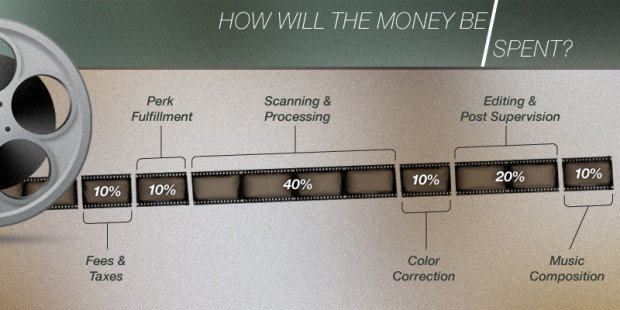
However, now that the rights issues surrounding the film (which had previously halted the film's completion) have been addressed, the only obstacle that remains is the is $2,000,000 sum required to complete the project.
Luckily for Orson, we now have a little something called crowdfunding, if only it has existed when he was still active...
Not only do I feel obligated to support this project as one of the great missing pieces of film history, but the intriguing person who was Orson Welles made of my most beloved films, no, not Citizen Kane, I am referring to F for Fake, without a doubt one of the finest and most challenging documentaries ever made.
I have pledged $10 towards the project's $2,000,000 goal.
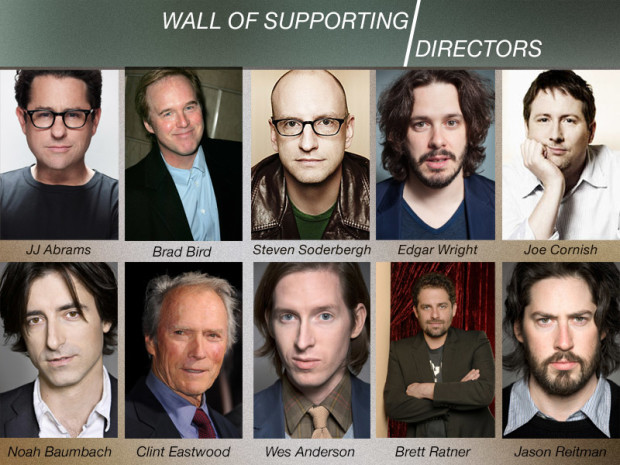
While $2,000,000 is quite a large ask for a film crowdfunding project, I am confident (and I have watched a lot of film crowdfunding projects fail and succeed) that The Other Side of the Wind will reach its goal; purely because it has such a vibrant legacy and stream of celebrity endorsement attached to it.
Edgar Wright is right, listen to him!
Probably the one good thing Brett Ratner has ever done.
I am always amazed (and sickened) by the amount of cinephiles I talk to who say how much they love film history, the grand figures of cinema and how they themselves would like to get involved... and then they pass on contributing a small sum to a crowdfunding project such as this.
However, at the end of the day a contribution of $10, $5, hell even $1 is hardly going to rob you of your pension... but it might just validate your status as an active cinephile who really does care about cinema.
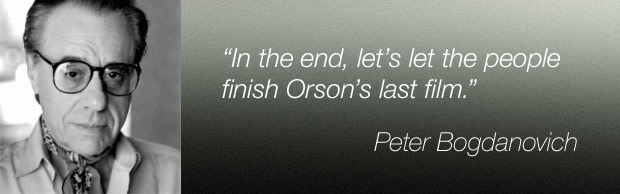
His name is Peter so he must know what he is talking about.