Thursday, 12 June 2014

Focusing Fencing: the preproduction of Fencing

As will be revealed in the Documentary, Bath Sword is a incredibly influential fencing club in this part of the country. It boasts the largest number of members in the west of England, with a program designed specifically to accommodate both professional and recreational fencers.

Fencing is a short documentary and reflective wiki that I co-created with my colleague, Thomas Wiltshire, for our final year BA (Hons) documentary project. The project was orchestrated between October 2012 to April 2013. For a more detailed overview see Fencing: an examination of the sport and an exploration of the documentary medium.

Presented here are all the posts from the wiki that deal with the preproduction concerns of the fencing documentary. I say "preproduction" in the broadest sense, because, as you'll see from reading what is collected here, some of the material is from the production period and this should really illustrate the constantly evolving back-and-forth nature of documentary making. 

Devoting a great deal of time and effort to your preproduction period is vitally essentially if you want to produce a strong result; as you'll see, our preproduction period enabled us to iron out many of the kinks in the project.


Project Overview, as outlined by Tom

Below is the initial project overview we outlined during preproduction in preparation for filming.


The venue closest to Bath Spa University, where anyone can try and take up fencing is Bath Sword Club.

It meets twice a week in the evenings on Monday and Thursday, with a kids session followed by an adult class.

I train and coach fencing at Bath Sword regularly and have a large number of good friends there.

A factor which has been paramount in making permissions, access and general ease of filming run far smoother than could possibly have been imagined.

I also fence every week in Bristol. However, the fencers there are far more competitive than Bath and do not necessarily excel in the qualities we most want to project (the notion of recreational fencing for anyone).

Nevertheless, if our minds change later in the production process the opportunity to film in Bristol will never go away.

As will be revealed in the Documentary, Bath Sword is a incredibly influential fencing club in this part of the country. It boasts the largest number of members in the west of England, with a program designed specifically to accommodate both professional and recreational fencers. With specific focus on the younger children who decide they would like to take up the sport. To accommodate such an interest at a young age there is a wealth of coaching staff and a veritable warehouse of equipment which can be borrowed by anyone. You are unlikely to find a better ambassador for fencing than Bath Sword Club in the entire country.


Concept

An examination of Fencing as a sport and a hobby as it exists in the modern idiom.

Combating assumptions about elitism and identifying challenges to both professionals & amateurs.

Culminating in a thoroughly entertaining, charming and interesting experience which will leave the viewer with a respect and admiration for a sport which truly deserves it.


Key topics of discussion which will be covered in interviews and expressed in visuals:

Kids

Why do you do fencing?

Will you keep fencing in the future?

26/02/2013 - Tom, over the course of our filming we have naturally encountered some resistance from a couple of the parents. With this in mind we took the decision not to interview the children and use visuals to express the answers to the questions we would have asked them. There is of course still time at this early stage to go back and pick out a few kids and there is a likelihood of that happening but we would like to get a first draft of our edit done first. To see if it would be entirely necessary.


Coaches

Why do you coach?

Threats to modern fencing, difficulties, obstacles etc?

Changes in fencing in recent history?


Adults

What have you learnt from doing fencing?

Why at your age did you take up fencing?

What do you enjoy about fencing?


Parents

Whose idea was it for your child to fence?

How did they start?


Narrative Structure and Sequences


Preliminary plan

Introduction:

Considering engaging a female narrator to describe the initial stages of the introduction. It would make an interesting contrast to the common misconception that fencing is a sport almost exclusively dominated by men.

Visuals of fencing as an elite sport. The best squaring off against one another under dramatic lighting, stylised post production effects and varying degrees of speed.


Quick, fast, aggressive editing to inject a sense of pace.

Cut to...

Warm up - young and old jogging and loosening up for exercise in a large sports hall. Very slow and pedestrian speed compared to the previous footage.

Cut to...

Interviews about how much individuals enjoy fencing (without mentioning the sport directly by name).

Persisting with momentary disbelief on behalf of the viewer that these thoroughly unprofessional people could never be engaging in the elite sport they just witnessed. 

This next section has a slightly faster pace to than the one before.

Cut to...

Footwork - practised by young and old at the direction of a coach. 

The notion that fencing is popular among these people steadily starts to dawn.

The speeds of cutting increases again by a similar factor.

Cut to...

Young and old in full kit: walking around the hall, facing one another, no fencing as of yet.

At this moment the incline of pace is broken. There is an expectant lull.

Cut to...

Everyone fencing. The cutting and speed of action is now far more aggressive and fast than in the previous shots. Building up to a climax.


1st half of the middle

Changing assumptions


Popularity:
  • Interviews -> 1 long, minimum of 3 short, parents & coaches. 
  • Visuals -> high angle (balcony overlooking sports hall), multiple tracking shots, on mass warm up & footwork.
Enthusiastic Children: 
  • Interviews -> very large number of short statements by kids, several longer observations made by parents & coaches 
  • Visuals -> close ups of happy, smiling faces. Eye level with kids, showing them both fencing and refereeing, the vast number of children running across the hall in stark comparison to the parents reading books and playing on ipads around the walls.

Variety of People:
  • Interviews -> ask people what they do in real life, contrast this to a slighlty longer interview with people who have fencing as a real career.
  • Visuals -> montage of each person after they state their job, contrast to the fencers again

Recreational Sport: 
  • Interviews -> focus on older generations or veterans (40 & over) talking about how much fun fencing is, perhaps collect together specific words which different people repeat time and again to create a montage. Finishing with one of the oldest member of the club sitting next to the youngest saying why they like fencing.


26/02/2013 - Tom:

Since this time our narrative has shifted and changed to suit the circumstances and time constraints we encountered.

The formula now is to take some of the old features and re-arrange them:

The introduciton will remain the same.

It will then be followed by two pieces: the popularity of fencing and fencing as a recreational sport.

The second half will begin with a look at the enthusiasm of the children fencing. Followed by an observation on the variety of people who fence.

Finally culminating in a take on the problems which modern fencers encounter, threats to the sport's way of life.

Pete and I have not yet decided on a final theme for our conclusion but rest assured it will be magnificent.


07/01/2013: Location Recce

Locations: Flounders Hall & the STV

Time: 19:00 - 20:00

As Tom already frequents these locations on a weekly basis he arranged for Pete to come up and have a look so that they could collaboratively assess the locations. This was done to assess their suitability for filming and to generate further ideas for the documentary.

Of the two locations, Flounders Hall was the only one they actually went inside and assessed (as Pete didn't have a pass, gaining access would have been problematic). However, they did have a look at the STV's entrance hall and the through the observations windows into its various sports halls. This gave Pete an idea of the space and lighting they would have to work with.


Detailed below are the main points of discussion that we raised.


Lighting

Tom had cited the lighting of Flounders Hall as being potentially problematic.


Flounders Hall is completely flooded with the sickly orange hue of the lighting. It doesn't help that the floors are reflective and the walls are of a similar colour!


However, Pete said that if there were problems with white balancing the camera then they could always colour correct in postproduction.


Tom even pointed out that the visual impression of the dingy quality of Flounders Hall could be contrasted with the pristine quality of the STV and we could incorporate this into our design for the narrative we wanted to tell about fencing - use the two different visual impressions to highlight two different aspects of the subject.

Accoustics

Again this was something that Tom had already given some prior thought. However, Pete was adamant that they speak to Rich Wood to insure they got the right mic for the locations so that they didn't spend extra time during postproduction fixing the sound. 


Permissions

As the Bath Sword Club were using the location it gave Tom the opportunity to introduce Pete to the hierarchial figures of the Sword Club. This is also where permissions to film the Sword Club and assemble a documentary were obtained.


Tim - Character Study

Likewise with the hierarchical figures, Tom was able to introduce Pete to Tim and secure his permission to make a character study based around him.


Filming locations

The filming of the Bath Sword Club is taking place in two locations at the University of Bath.

Founders Hall


Aside from the lighting which the NX5 struggles to white balance against, this location has lots of space to operate in, a balcony to film from and pretty good acoustics.


20/02/2013

As editing begins I'm becoming more and more aware of the advantages the difference in lighting yields.

It can - and most likely will - be employed to both emphasise and enhance certain scenes which bare association with a deep, warm colour palette.

Making the contrast in pigmentation - developed between the Founders Hall and the STV - provide a potentially dramatic and captivating dialogue between visuals and interviews in the editing choices.


The lighting isn't a problem in the STV, the acoustics are fine and there is enough room to film in. The only real problem is that the fencing club uses two different sports halls which means you can miss something interesting in one hall while you're filming in the other.


Equipment

Sony HRX-NX5 Camcorder Kit

Tom and Pete decided to use the NX5 due to its overall similarity to the Sony Z1 and mainly because it captures straight to scratch disk which eliminates the need to log and capture from a mini DV tape.


While their experiences of operating the NX5 have been largely without fault, they have encountered some problems with the log and transfer process for importing the digital files from the scratch disk.


Sony PD 175

As Tom had booked out a PD 175 for another project, he decided to use this in addition to the NX5. 

The PD15 did create aspect ratio problems but those complications have been easily bypassed in the early stages of the editing process.

Having a second recording of the skilled fencing bout was absolutely necessary. It is actually developing its own interesting solution, because it represents a type of footage, which in comparison to 1080i, looks quite archaic. Just like a large number of contemporary opinions about fencing itself.


Radio Microphone

The radio mic has been used when interviewing, as it provides very clear sound because it is attached to the interviewees. However, most of the shorter interviews have been done with the NX5 external microphone.
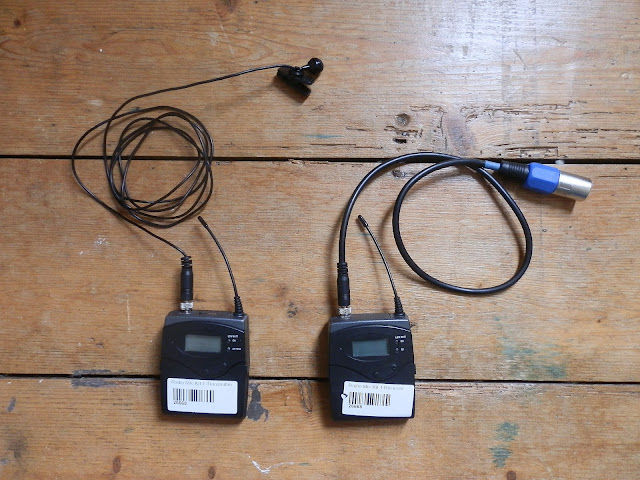


I cannot even begin to adequately express the praise necessary for this piece of kit. In two locations where sound quality is constantly compromised by shouting children, clashing swords, buzzers and quite frankly sonorous walls they were a complete life saver for some of the more shy interviewees.


NX5 External Microphone

Essentially a miniature version of a 416 or K6, this microphone attaches to the NX5 and still captures a very large sound field that sounds nearly as good as anything the 416 or K6 would capture. For this reason the external microphone has proven to be the dominant microphone used throughout the shoots. It has even been used to capture the audio for some of the shorter interviews, Tom and Pete have found that if the interviewee is close enough the microphone is able to clearly pick them up.

The NX5 with the NX5 external microphone attached.


416 Microphone Microphone Kit


Rich Wood suggested this microphone after the issues with acoustics in Flounders Hall were explained to him. It was used while filming the one-on-one coaching in the character study. However, it was very quickly abandoned due to difficulty with using it when filming solo and generally be a nuisance in regards to the cables when the camera is handheld and in motion. However, it was retained for shoot 2 in case the NX5 external microphone failed.


K6 Boom Microphone Kit


The K6's overall similarity to the 416 necessitated it being booked out when the 416 became unavailable. It was retained as a back-up for shoots 3 - 6.
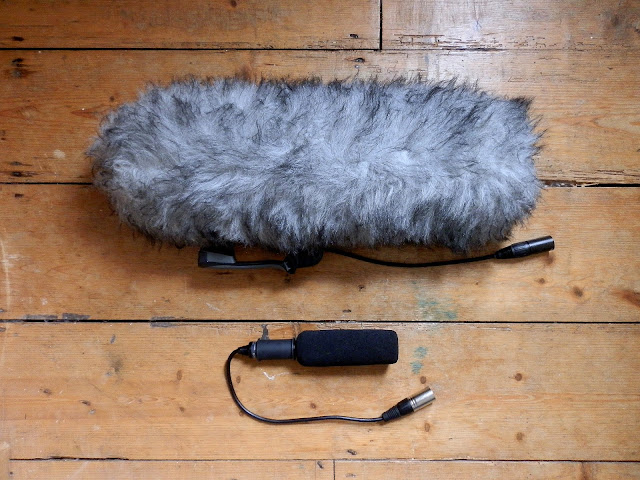
Notice the size difference between the K6 (top) and the NX5 external microphone (bottom).


Manfrotto Tripod

This has been used for its wide functionality for a variety of camera moves and its sturdy form which enables it to sit quite firmly in one position. While it has been used throughout all the shoots, it hasn't been employed with every shot. Both Tom and (especially) Pete have expressed irritation with the time and energy that is wasted with moving and readjusting the tripod.


Boompole

This was retained in case it was needed to assist with either the K6 or 416. Ultimately, it wasn't used.


High Visibility Jacket


Pete has been wearing one of these as an extra means of reassurance through the shoots and also because he is less familiar to the members of the fencing club.


After all this research and preparation we were surprised to find that in documentary making the filming period also acts as an additional research and adjustment period...

Tuesday, 10 June 2014

The Miracle of Crowdfunding: Update #2.2 Pete's Masters crowdfunding video: do you want to come with me? (11/06/2014)


Script

Still working on it. Maybe tonight, if not tomorrow. 

I am compressing it slightly and making everything flow more logically. 


Filming

I am thinking get into Uni tomorrow - 12/06/2014. Get into Uni before 12. 10 ideally.

Potentially do some filming tomorrow, but the priority is to get the planning and shot list done and the equipment out. It is a bit haphazard, but we will have to think on our feet with the documentary, so it's good practice.

Friday 13/06/2012 - come over to Bristol to do some filming at my house.

Monday 16/06/2014 - complete the university and bath filming filming.

Spend the next couple of day editing.

This will make sense when you have read the script


To do ASAP:

1. Email Tom, Rich and Leila (to insure we reach the right person). Book out equipment:
    • Sony NX5 kit
    • Tripod
    • Steering wheel
    • Reflector
    • Radio Mics - the sennheiser EW100G2 ones.
    • SLR Kit
2. Email rooms@bathspa.ac.uk and book out a seminar room for tomorrow 12/06/2014 and Monday 16/06/2014.

Tell them we need to do some illustrative filming on a whiteboard filming and see if they can book us a room that has good sources of natural light. See if you can get rooms for a good couple of hours.


3. Email technical support in the library and get them to sort out your wifi.


Style and pace of the video

I am thinking very much along these lines, you'll see when you read the script.


Music

If you know any music sources where we can clear the rights, then let me know. The video will need a musical presence.


Crowdfunding

If you have not already done so have a listen to this overview of crowdfunding:

Rebel Seed Podcast – Film Insights Edition: Crowdfunding Essentials For Filmmakers
I have also put together a YouTube playlist overview:

Crowdfunding Mechanics

This is going to come in handy later on!


When we meet up tomorrow, we can discuss this some more. Bring any notes, queries, suggestions, etc. I will try to get the script to you tonight.

Friday, 6 June 2014

The Miracle of Crowdfunding: Update #2.1 - Getting the ball rolling and filming it! (07/06/2014)


It was good seeing your yesterday, George. I hope you are recovered - there is much work to be done.


Treatment

On it. It's a coming...


Practice filming - a project that is good to go, sort of

It occurred to me yesterday that I have a project that is ideal for getting a bit of practice filming in - my Masters crowdfunding project campaign video.

I had an initial idea for it a couple of weeks back that was quite ambitious.

Then I scaled it back into something more simplistic that I could create on my own.

Now, or rather last night, I figured out a way of doing it ambitiously and simplistically at the same time. It also transmits the exact message I need it to transmit - it is absolutely bonkers!

The idea is literally about getting out of the box...

On Monday, I am going to very quickly bash out a script that can act as a rough guide for the visuals and a definitive script of what I need to say.

The reason why this is going to be a good practice shoot is because it is going to require a great deal of gorilla style filming in Bath and up at the university. Maybe some in Bristol as well, but I might be able to do the Bristol filming on my own - tell me what you think when you have read the script. 

The video needs to have a ferocity in its film form that can only come from a spontaneous approach to the filming. 

But it does need to have a high stylistic and artistic value - the reason I am not doing my campaign video as a web cam job is because I am asking for funding in a course in which I am going to be doing filmmaking at a premium level - it's all about image.

Additionally, as much as this is campaign video, I want it to stand as an example of our work that we can flaunt.

I will also need help editing it and, again, this needs to be done in a relatively short space of time.

The idea is to have my crowdfudning campaign going while we start to do the initial filming for the doc, so as to take advantage of all the new contacts (and donators) being made through the process of enquiry and filming. It's all about making everything work for everything else.

In terms of when - Thursday and Friday this week and some more filming the following week if necessary. 

It needs to be about 3 minutes, but maybe with some more... I'll send you the script.

If you help me with this, so that I can get funded, AND I will get funded, I will help you fund any further study you may decide to undertake.


The Masters I was telling you about

MA Documentaries and Features


For part-time work

I am deadly serious about this

Jobs at Lovehoney

Based in Bath, it is the UK's biggest and may even be the world's biggest distributor.

The chap who started it up is a graduate of the University of Bath. I was at an Entrepreneurship talk he gave up at our university in December and I was hugely impressed with his personal approach and business acumen - he really does think outside the box!

At the time, he was also saying that he is usually short of warehouse people.

The worst you could do is send them a copy of your CV and an appreciative email.

The whole business has just gone from strength to strength since it was first launched.

I have been keeping an eye on Lovehoney, because the nature of its business does have a strong baring on the web series idea I have been developing.


Contacting the Bath Film Festival

Get on that and get in there! Think long-term...

Anyone can apply to do something and most people do, but the ones who really stand out and gain entitlements are the proactive ones you can think on their feet.


Watching docs and Studying docs

Searching for sugarman, etc., ect., etc...

Don't forget to give the following a read:

Digital Storytelling: The Digital Video Documentary

Look at, read, share anything else you think may be of use.


George's projects

Get on them!

Bring all of your ideas together.

Quickly bash out one outline, put it aside - do this 5 times over.

Take on outline - quickly bash out a script, put it aside - do this 5 times.

Film them ferociously at the same time - use the summer to get all of the footage you need.

Then spend all of final year editing and perfecting them.

Simple.

Technically, my crowdfunding video counts as a project, so now you need to cough up 1, but 6 ideally.


Remember - time is more valuable than money!

I have to work tonight and tomorrow night - that's 20 hours of my life I will never get back.

You're a student (and any graduate will tell you this) - you really do have all the time in the world, more than enough time to get 6 micro films made BEFORE your final year.


Monday, 2 June 2014

The Miracle of Crowdfunding: Update #1 - Intro and ideas [03/06/2014]


The blog is up.

I have been gradually pulling together all of the research resources collecting them together here - see the links either side of this post. 

My aim is to have this blog be its own little self contained database for the documentary.

Not everything is here yet and new things be added along the way. 

But feel free to have a look around.


Cinema Theatre Association - link

I came across this and can see that it will be of MAJOR USE - an organisation that is concerned with the cultural heritage of cinemas in the UK.

It even has dealings with the Whiteladies Picturehouse here in Bristol. 

I am going to invest in a membership. 


Vlogs

As I did for EYES, I am going to be recording video logs for this project. They were invaluable when I was orchestrating EYES - they allow me to get my head in order.

We worry so much that the ideas in our head are not any good or do not make any sense; then you record yourself saying them out loud and watch yourself back... and then you realise: "I've got it spot on there."

The EYES vlogs saved me many sleepless nights, as I am sure the Breaking Cinema ones will as well. 

You don't have to watch them, but you are more than welcome to.

It is up to you, if you want to do some vlogs for the project. If you do, do it via an unlisted video on YouTube.


Documentary filmmaking

I have bee re-familiarising myself with documentary filmmaking and this is why I have been gradually reposting the Fencing wiki posts on my blog - build on what you already know.


Research, planning and preparation is key!

If you have not already done so, have a look at:

Visual Storytelling: The Digital Video Documentary

It is only 44 pages and is a concise overview and introduction to documentary filmmaking. 


Proposal and Treatment

To be clear:


  • A proposal - is a portfolio package that contains the treatment, budget, sechedule, research, showreel test footage, etc. Basically, it is the planning portfolio for the creative enterprise project module (see EYES Planning Portfolio) or, if you want to get a little more ambitious, the entirety of EYES is a proposal - I described it as being a web series concept proposal package (see EYES Concept Proposal Package).


  • A treatment - is a descriptive overview of the narrative spine and visual style of the documentary. Very similar to a treatment or outline for a fictional film.


I am going to be putting together a very strong proposal package together over the next couple of months, because:


  1. It will get the entirety of the project thoroughly organised.
  2. It will show that we mean business and that we are goddamn serious about this undertaking.
  3. We can use it to win subjects over (subjects being the buildings and people we want to film).
  4. It will assist with the planning of the crowdfunding campaign
  5. Funding. Getting traditional funding for this project is not entirely out of the question, but you can only get it if you have a strong proposal. I am not anti-traditional funding, I am anti-getting-fucked-in-the-arse! So we'll see.
  6. It will show that we mean business. Did I already mention that? Well, I am going to keep mentioning it, because I do mean business!

The filming I am keep to get done this summer and autumn, I very much want to cut together into a showreel/microdocumentary that can be included in the package - we'll come back to this.


I have been giving the treatment of the documentary some serious thinking. It helps that I have a slight throat infection, so I have been quite delirious at points throughout the last couple of days.

In order to warrant this project being a feature and not just being a documentary where:

this cinema and this is its history and this is another cinema and this is its history and this is another cinema 

The documentary needs to transcend that and it needs to tell something bigger and something vastly deeper and it can only do that with a fully realised narrative.

Having a fulling realised narrative, as laid down in a treatment, will allow us to narrow down and sharpen the focus. I can see now that this project is going to supply us with a plethora of material - way too much for a single feature documentary and the narrative will enable us to find the signal in all of that noise.

I have had many ideas about the narrative - nothing definite and nothing fully cohesive yet - but it is definitely coming. Things that I keep posting in the facebook group and in the pinterest boards are very much mirroring what is on my mind in regards the narrative spine - we will discuss this in due course.

Once I have a strong narrative treatment is done - that is when I will reach out to filming subjects.


Offshoots of this project

Obviously,  have been going on about the short subjects we need to make in conjunction with this project and we need to get on top of those - get those outlines done, the only time is now!

However, as this project is going to generate a plethora of content that the feature won't cover all on its own, I have had a few ideas about some smaller projects that we can spin-off of this project and use to promote and strengthen this project.

The whole point of this passion project is to put us on the map and it stands a hell of a lot more chance of doing this if comes out with an army of guns blazing in different shapes and affiliated forms.

I will discuss some of the other Ideas I have had later on, but suffice to say that my research over the last nearly-year has not been in vain - this project is goldmine in terms of empowering us to do what we want!


Practice filming

We need to go into uni, get the equipment out and re-familiarise ourselves with the kit.

Nothing to intensive, just get the kit out on campus and do a bit of observational filming to wake up our documentary eyes and practice at our handheld camera work.

Projects like this - where everything is always against you - only ever work when you relentless keep the momentum moving and building.

I am thinking:

05/06/2014 - Thursday
or
06/06/2014 - Friday

Let me know if you are free on these days, we can also use them to discuss other ideas about this project and other projects besides.

We HAVE to keep the momentum moving - it is the only way this is going to work.

There are busy and exciting times ahead... and the best part?

We've already started!

Wednesday, 28 May 2014

The Miracle of Crowdfunding: Brief v.1 - Let's get this ball rolling (again)...


"You know, it might be just this one anonymous glory; of all things, this rich stone forest, this epic chant, this gaiety, this grand choiring shout of affirmation, which we choose, when all our cities are dust, to stand intact: to mark where we have been, to testify what we had it in us, to accomplish." - Orson Welles, F for Fake, 1973

A feature length documentary exploring the practice and heritage of the cinema.

Breaking down the cinema

Breaking Cinema - working title

Documentary treatment and proposal -currently in formation

The documentary is less about fact and more about form.


This brief will evolve as the project progresses and I will post up a new version of it as it does, that way we will have a record of how the brief evolved - the making of a documentary is just as interesting as a documentary itself. 


"Right, let's get this ball rolling... it'll be an avalanche by the time I'm finished! Mark these words..." - Pete, Facebook Group, 20/05/2014


It's a comin'...

My POV: for the fencing documentary and in general


Visual silence, repulsion against the shackles of boredom, the compartmentalisation of a person, narcissistic appraisal, old in young, young in old, suspicion of structures/institutions/traditions, the paradoxical self, a hatred of complacency, the central drive of anger, a yearning for knowledge and an appreciation of the intellect.

Defining your point of view is always an incredibly tricky business, but if you want to be successful in your approach to any endeavour  - gaining a thorough understanding of your own motivations and inclinations is paramount! 

Presented here are all the POV posts that I generated for the documentary module of the final year of my BA (Hons); in which I co-created a short documentary about fencing and a reflective wiki with my colleague Thomas Wiltshire. The project was orchestrated between October 2012 to April 2013. For a more detailed overview see Fencing: an examination of the sport and an exploration of the documentary medium.


"The impression I get from you Pete is that you want to change peoples' points of view." 
- Mike Johnston, Senior Lecturer in Creative Media Practice

While I did find my POV quite daunting to define - objectifying yourself is never easy - gaining that knowledge has ultimately proven to be invaluable in all of my creative and non-creative pursuits.
 
Something to do with Film is very  much about my POV, even though it has taken me a number of years to realise that fact.


I was immensely pleased with the reflective POV material I generated and, looking back at all that material now, one year later, it is amazing how integrally it still holds true. 

If you are interested in defining your own POV, then what I have presented here may be of some use.

My POV post is comprised of the following:

  • my POV in visual form - a short video montage using my photography to demonstrate my POV.
  • my creative identity profiler results - an exercise devised to define your POV in relation to your creative inclinations.
  • My Land of Puddings - another short video montage demonstrating my POV in regards to juxtaposition and my national identity.
  • a few bullet points provided a slightly more thorough explanation of my POV.
  • a conclusion that sums up my overall POV in regards to the fencing project and how my POV has informed my approach to making the documentary.

If you want to understand my POV, this post is a pretty thorough explanation...


My POV - my point of view in visual form (1:26).


My creative POV a.k.a. my creative identity

This is actually the third time I have gone through Rabiger’s Creative Identity profiler (see Directing the Documentary by Michael Rabiger) so my answers should be pretty conclusive! I apology if my summary seems a bit abstract, but I felt the best way for me to draw together my creative Identity was through stream-of-consciousness writing.


My Creative Identity Summary

  • The themes that arise from my self study are visual silence, repulsion against the shackles of boredom, the compartmentalisation of a person, narcissistic appraisal, old in young, young in old, suspicion of structures/institutions/traditions, the paradoxical self, a hatred of complacency, the central drive of anger, a yearning for knowledge and an appreciation of the intellect.
  • The changes for which I want to work are an illumination of the intellect and an understanding of the subtext.
  • The kinds of subject for which I feel the most passionately are one’s that offer self-reflexive viewpoints and that expose the underlying pulse of a situation or establishment. Conflicting ideologies/institutions/temperaments is another area that offers me much intrigue; as does the subject of juxtapositioning completely different ideas to create a result that represents something greater than the original constituent parts, and which forces the spectator to question their own assumptions and beliefs.
  • Other important goals I have in mind are to maintain the visual imperative of telling something that should be told visually and not to be fearful of using a lie to represent the truth. If a film lies then it is only presenting a truth of reality - everyone lies!


My POV on Great Britain: My Land of Puddings


"This exercise experiments with music editing and meaning/association and ironic images counterpointed against them. Find or shoot images that contrast it’s lofty ideals with an alternative ironic reality. 

Use found footage/stills or shoot your own. Edit to the beat points in the music. Work with ironic juxtaposition 

If you want to music edit the verses so that you can work with less familiar verses/sections, then do but you might find the edit tricky." 


- Mike Johnston, Short Documentary Making tutor 


With this exercise we had to use the Land of Hope and Glory backing track, as performed by Clara Butt, to produce a video montage that experimented with juxtapositioning images and ideas of the British national identity; in relation to our own POV of Great Britain.

I have always found the subject of the British national identity a tricky subject - mainly because it does not actually exist.

This country has been invaded so many times throughout its long history that, in terms of genetics, the "British" people of today are European. Additionally, pretty much every cultural tradition that is practised in this country was at one point "borrowed" from another cultural and country - we acquired the cup of tea from China and I have even heard some people refer to the curry as being British!

If there ever were any true-born-and-bred-British-people, they no longer exist, genetically or culturally. Britain, or Great Britain, is just the name of a landmass that houses a vast multicultural collection of peoples and traditions that we have come to associate with the identity of "British" - Britain is and always has been a multicultural nation, embrace it and celebrate it!


My Land of Puddings (1:50).

As you would have seen from the video, my montage was quite dark and I intentionally made it so, because I knew everyone else would produce a highly positive portrayal of Britain and I wanted to leave a lasting impression.

While I think it is always good to have a positive outlook, it can lead to wilful blindness in regards to the more the negative aspects and I very much wanted to point out the fallacy of the "traditional-stiff-neck-British-national-identity" and the social problems we sometimes/almost always try to hide behind it.

I kept the subject matter quite current: 


  • the country was still buzzing from the London 2012 Olympics.
  • the Jimmy Seville scandal had just become public knowledge and was causing a mass condemnation throughout the UK.
  • the financial crisis was still causing ripples.
  • the 2011 London riots.
  • Baby P was still being discussed as a major example of how "the system" was failing this county. 


Additionally, I also touched upon some of the more deeply ingrained historical aspects of this country: Guy Fawkes and the crimes of the British Empire.

My Land of Puddings was very much about challenging the established and commonly held point of view. When we viewed it in class, it was evident to see that it made an impression on everyone who was present, there was silence and unease after my video ended. 

However, My Land of Puddings was also about reinforcing what is truly great about this country. This country may borrow from other cultures, but that is what make it great, because it is an amalgamation of so many different cultures and a strong promoter of multiculturalism. 

AND out of all that amalgamation, this country sometimes does bring something original to the table, which in this case is a Yorkshire pudding (or, sub-textually, the rather odd British sense of humour). 


Ultimately, through presenting a dark portrayal of this country I endeavoured to remind people of the small things that truly do make Britain great.


My POV (up until late 2012) explained...

Below I've attempted to explain some of the themes in My POV video, from way up above, I apologise if some are a bit abstract. 

While my explanations would probably be much clearer as a mind map, here I have recorded them via stream-of-consciousness writing...


Seeing and Visual Thinking

  • I’ve always been a visual learner/thinker and I think this is one of the reasons I tend to be quite plain-spoken. I don’t rate human verbal interaction that highly; to me, it distracts my attention from what I’m looking at.
  • I promise you, you will learn so much more about a person by watching them than you ever will by listening to all the stuff that spiels from their mouth.
  • My attitude has always been: show me you can do it, don’t tell me you can do it (anyone can say they can climb a mountain).


Films and visual storytelling

  • I love films! I appreciate them as they’re visual (the really good ones are) and, I suspect, I get my visual thinking from films, because I couldn’t really read or write when I was younger. Films were always there as a fixed frame of reference that I could always go back to, that I was always able to understand and they’ve always helped me to better understand the world.
  • At the moment, as they provide the most stimulating experience for the senses, films are one of the preferred means by which Humanity likes to indulge itself in stories. To me, like all means of telling stories, films are Humanity’s way of rationalising the world; If we didn’t have a means to rationalise the world – we would go insane. But, more important than rationalising the world, films allow us to escape the boredom of everyday life (which can also make you go insane). Therefore, I have a great respect for films and the power they exert over the Human race and I have always bee hugely interested in exploring how they have this power.


Photography and Contexts

  • Taking a photograph is the same as making a choice. Once you have a photographed a framed composition in a particular way you have locked it into a particular context. Likewise, once you come to a decision you have taken a set of pre-thinking that frames your decision in a particular context. Once you realise this, photography becomes a great way to open your eyes and become very open-minded.
  • When I take a photograph I do externally what my brain is visually doing internally. The rewarding thing about a photograph is, as much as it is a photograph of something separate from yourself, it is a photograph of something very familiar to yourself – your internal thought patterns.


Structures and Compositions

  • Physical structures and architecture have always fascinated me. I like how particular arrangements of shape and form can be manipulated to generate specific emotions.
  • Even re-arranging already established arrangements can generate a greater effect, such as with Film Noir. Film Noir turns the conventions of lighting, shadows and framing on their heads to convey an impression that intensifies the story being told.
  • When I was younger I loved to play with Lego. For me Lego allowed to take these already fixed pieces of structure, which I could then add together and arrange into new compositions that we’re always more fulfilling than their base components.
  • Video editing taps into my appreciation of structures and compositions and it allows me to exercise this fascination. This is why I enjoy editing so much; it’s an adult equivalent of playing with Lego - it exercises the same mental discipline.
  • I've always been fascinated by the structures of trees and the pattern that their branches make. That pattern, it turns out, is actually a fundamental pattern of nature; its called Constructal theory and it's the reason trees, water tributaries, lung airways, lighting, brains, etc, all share the same basic pattern. It is argued, the reason for its continual recurrence is: "For a finite-size system to persist in time (to live), it must evolve in such a way that it provides easier access to the imposed currents that flow through it." I find this absolutely amazing (see Motivations and Subtexts).


Motivations and Subtexts

  • I’ve always been interested in psychology (it’s the one area I regret not taking academically). For me, psychology makes life much more interesting because it exposes the subtext and subconscious of everyday life. If I can’t pin down the psychology of a person, I find it increasingly hard to trust that person.
  • As much as I’m interested in psychology, I’m also interest in biology and how human biology interacts with psychology, and vice versa.
  • The nature of what reality is and each of us construct our own realities has always intrigued me.
  • Why and how things work has always interested me.


Knowledge and Studying

  • At the moment, my degree is the single most important thing in my life. Everything else is secondary and I am, literally, investing everything I have into my degree!
  • I hate not having anything to do or to work on and this is why I enjoy studying so much (as long as it is in an area that interests me). I just like to have things that I can pull apart and put back together again (see Structures and Compositions).
  • I respect the power of knowledge and the advantages of being open-minded. I wouldn’t say that I have always appreciated these, but I certainly do now!


Habits and Principles

  • I’ve always been absolutely stunned by how a person can pick a principle and then through determination of sticking to specific habits achieve what is seemingly an impossible outcome, such as Bruce Wayne does with Batman (the Nolan films perfectly demonstrate this).
  • I’m big on habits and on nurturing the better ones. Sticking to strong habits strengthens character, as I learnt from my swear sock. I went a whole month without swearing (well I swore 23 times) and, amazingly, I don’t swear at all now!
  • I can’t stand people who say they’re going to do something… and then they don’t do it. I have a strong principle of sticking to the things I say I’m going to do. Then If I’m not going to do something I let it be known, opposed to sticking my head in the sand.


Time and Favourites

  • There’s the saying that time flies when you’re having fun and, equally, you could argue that if you’re doing something very benign, such as walking down the road, time seems to slow down. But time doesn’t slow down or speed up; it ticks at the same rate regardless of the situation. Time is very important to me because we really don’t have a lot of it and you would be incredibly foolish to waste it.
  • I’m also interested in what time is and how it can be manipulated.
  • I can't stand the question: "what's your favourite...?" I try not to have a single favourite in something (I have forty favourite films); I think to have fixed singular favourites in every area of your life is to be very narrow-minded and will stop you from trying new things. However, when it comes to food I can hands down say that my favourite food is pancakes! I allow myself to have pancakes as my favourite food because there are SO many different things you can have pancakes with and, therefore, they don't stop me from trying new things.


My POV on fencing


A spur-of-the-moment recorded exclamation of how I viewed fencing (5:37).

Essentially: 

  • I have a completely different POV to Tom's - I'm on the outside looking in and Tom is on the outside looking out. 
  • My POV is closer to the audiences POV and I am able to ask the questions the audience would ask. 
  • My POV has evolved as a result of filming the documentary. Observing and interacting with the subject matter has made me less ignorant towards fencing. 
  • My artistic approach on the documentary is also different to Tom's. I'm a realist: I'm interested in capturing the subject matter as it happens. Tom is a formalistic: he's interested in using the assembling of the film form to represent the subject matter and the themes of the subject matter. 
  • While making the documentary, I have discovered I have a deeper connection to fencing. For me, fencing has many parallels to skiing. Skiing is something I am very enthusiastic towards and which I want to refine. Through this parallel I am able to essentially identify with a fencer’s POV.


I'm sure there's more I could say, but this is all I'm going to say.

However, why not check out the rest of the Fencing documentary project that all this material was originally generated for...