Friday, 25 November 2011

Where will it all stop – Filming Feedback


This summary post was originally written for a practical exercise undertaken in the Planning and Making a Film module I undertook in the penultimate year of my BA (Hons). The module's practice was undertaken between October 2011 to June 2012 and it provided me with a hugely enriching experience. For a more detailed overview of the module and the projects I undertook as a part of it, see Planning and Making a Film: The student filmmaking experience.


21/11/2011

As a seminar group we discussed how filming for each of the groups had gone and from this generated some feedback points for ourselves and for future students. All the points raised from the session can be seen here. Below I have outlined all the points from the session that I feel would be good for myself to consider when it comes time to make the second short film.


Be positive! 

Ironically, being the most negative person in the session this was point that I raised. I certainly took a very negative outlook on things when our filming went bellies up. While my negative outlook didn’t stop me from performing my role it certainly  dampened my spirit and stopped me from performing my role to the best of my abilities.


Roles. 

Make sure that everyone knows what their role is and what responsibilities that role entails. I included this point not because I didn’t know what my role and responsibilities were but rather I found very frustrating when our production manager, Sally, kept asking me what it was she was meant to be doing. Therefore, what role and responsibilities everyone has should be made clear as soon as possible.


Locations.

This was a big one for us because we hadn’t checked properly in advance what part of our location, The Royal Oak, we could actually use. Therefore, it was a blow in the guts when we were told that we couldn’t use the part of the pub we had spent so long planning for! Establishing how much control and access you have with a location is key in ensuring that you can shoot what you want and where you want to.


Cast. 

We had issues with not being able to contact cast members and with cast members dropping out. Here we should have been clear with our cast members as soon as possible in terms of how to contact them, making sure they were available when we needed them and generally keeping them in the loop.


Rehearse. 

This will save so much time on the day as the cast will know what it is they need to do.  If you plan a rehearsal properly, it is also an opportunity for all the cast and crew to meet and become familiar with each other before the shoot.


Lighting. 

Make sure your location has lighting that you would be happy to film with and if it hasn’t arrange to have your own lighting set-up. This proved to be a particular annoyance for me when we were told that we would have to use The Royal Oak’s back room, opposed to the one we had planned for, because the lighting in the back room was completely different and worse than the lighting in the main room.


Schedule. 

This was something that we really only had a very vague idea about and that was because our production manager hadn’t bothered to produce a proper one. It would also have been helpful if we had allowed for more time than planned, e.g. we had a three hour shoot, but if we had put an extra hour on top of this it would have helped when things started to go wrong with the shoot.  


Follow continuity. 

Aside from filming all the scenes we needed to film back to front (our shoot order was: scene 6, 2, 1) we managed to shoot everything that was in the scenes in chronological order. However, we deviated from continuity at some points because we were trying to save time with what little time we had, and I know this will lead to some continuity errors in the finished film. But, obviously, if you can shoot in continuity order then plan to do so; it leads to less confusion, both with the cast and crew, and will allow you stay on top of continuity.


Don’t panic. 

Things can and do go wrong, but don’t panic when they do because it will only make the problem(s) worse. Obviously, planning can help stop things from going wrong, but it you have a plan B as well then you’ll absolutely be set if things start to go wrong with your original plan. Also, if you have a problem don’t keep it to yourself. There is a cast and crew there for a reason and that is because making a film isn’t a one man job, so why should bearing a problem be any different?


Thursday, 24 November 2011

Xbox Junkie - A Short Film Script

Xbox Junkie is a script that I am developing for my housemate Michael Kelly, who is a third year Creative Media Practice student in need of a script for his dissertation short film. Thus far I have spent one week developing the idea and another week writing a first draft that consists of thirty pages. 

I have developed the script from an original brief that Mike gave me, which concerned itself with a middle aged man who had abandoned his family and social ties because of his new addiction to playing video games. This was actually something that Mike had been inspired from a similar story he had read in a Guardian article: At War with World of Warcraft. Although, not being much of an avid a gamer, I didn’t really find that idea all too appealing. However, before deciding to make a fiction short film, Mike’s original intention had been to make a documentary about gaming so I decided to use the theme of gaming as my starting point.


The resulting thirty page script, certainly the most ambitious script that I've written, concerns itself with a protagonist who uses gaming as a means of shielding himself from the real world. Hence the naming of the script as Xbox Junkie, because the script explores how gaming can become an addiction; that can produce the same results of being addicted to drugs. While game addiction isn’t something that is yet recognised as a proper addiction it is certainly something that keeps getting re-examined in this respect and is something that keeps cropping up in the news: Why anything can be addictive.
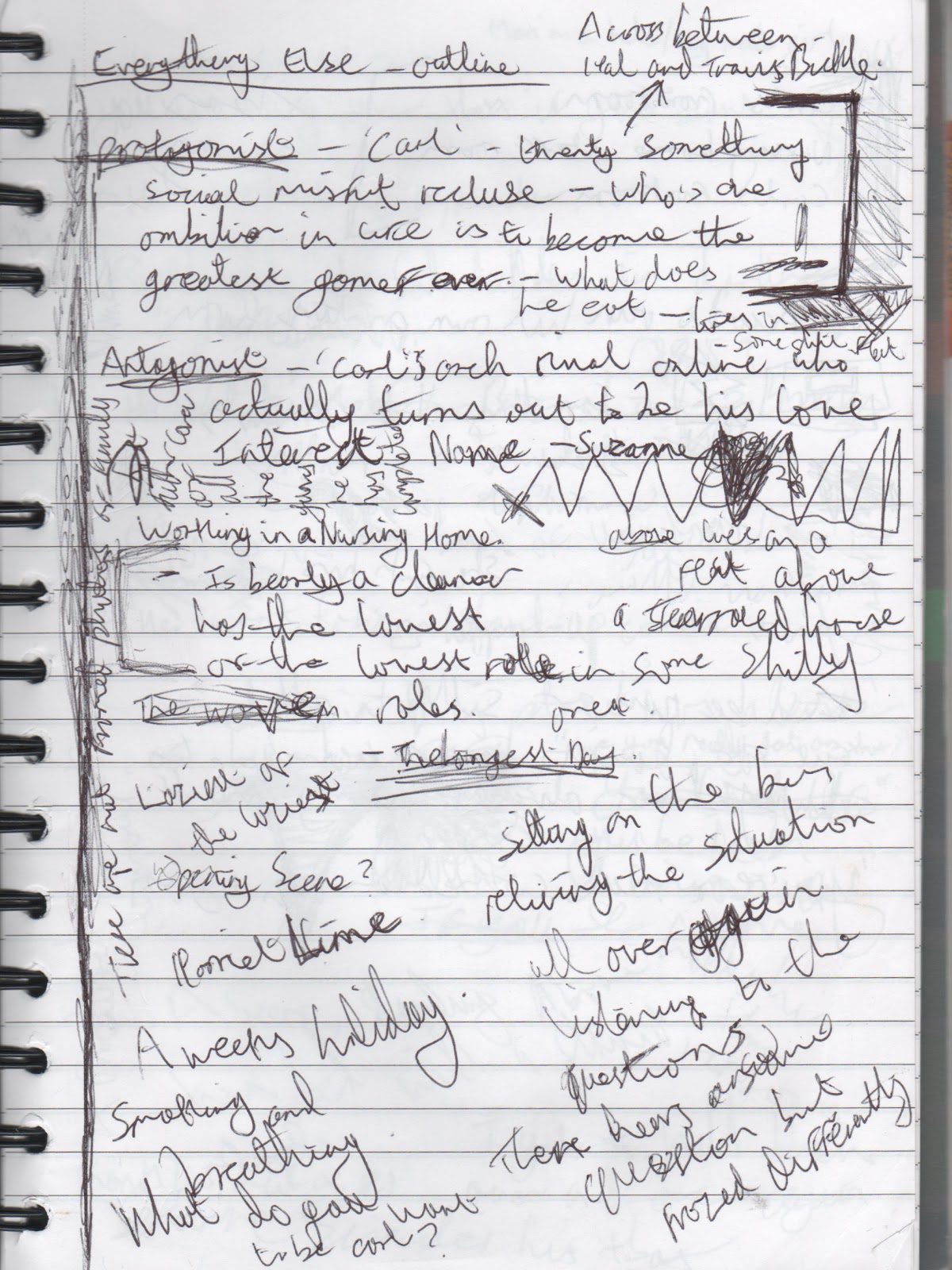
Initial outline, if you can believe that
The protagonist uses gaming as an excuse/shield to stop himself from achieving his true potential – his true potential being something that contains a lot of pain. With this theme of game addiction at its center the script goes on to explore how the protagonist breaks free of his addiction while also exploring how he got addicted to gaming in the first place. If are to look at the script in terms of story types then it is a man in a hole combined with a boy meets girl.

The scene outline
On a series of bus rides, I have gradually been reading the shooting scripts for American Beauty by Alan Ball and North by Northwest by Lehman Ernest. I made a very conscious decision to read these scripts because I wanted their respective styles to rub off on my script. From American Beauty I was looking to gain the existentialism as seen through a lens of black comedy with the humourous and snappy dialogue of North by Northwest. I’ve always enjoyed black comedy so it seemed like an essential when writing this script because I envisioned this script being quite comedic. Also the script would be existentialist through its examination of game addiction and using that as a shield against the world. Finally, as the script is also a boy meets girl story I wanted to inject it with that sparring quality of dialogue that you see in couples who just seem to click.


While the style might come from American Beauty and North By Northwest, the content comes from things in my life and from the people I share my current house with. Certainly, the idea of the protagonist spending most of his time sat on his Xbox is something that a particular member of our house, who will remain unmanned, has been doing to no end! Also, the idea of preventing anxiety from getting in the way of your ideal career or dream is something that keeps recurring in our house. The idea of time running out and the mortality of humanity is something that is also present in the script, and it is because I am currently terrified of wasting time! At the moment, the script is only a first draft, but I hope that by drawing in these very real themes and emotions it comes together to tell a very convincing story.  

That all said, though, this script may not get made! It is not because Mike doesn’t like it, far from it. Rather, it’s because on the night I handed him the first draft I came up with an idea of how I could turn his original idea, of the middle aged man who had abandoned his family and social ties due to his new addiction to playing video games, into a script. For the time being then, I have laid Xbox Junkie to rest while I produce a first draft of this new idea, and I will soon have more details about it.

Where will it all stop – Filming


This summary post was originally written for a practical exercise undertaken in the Planning and Making a Film module I undertook in the penultimate year of my BA (Hons). The module's practice was undertaken between October 2011 to June 2012 and it provided me with a hugely enriching experience. For a more detailed overview of the module and the projects I undertook as a part of it, see Planning and Making a Film: The student filmmaking experience.


20/11/2011

Naturally, it was at this point in production that everything started to go wrong! The first problem we encountered was one that we should have seen coming – casting. The first issue was with the character of Lolly, who we had had problems with previously. The actress we had cast to fill in for Lolly did manage to film all of her material for the Saturday, but was unable to shoot on the Sunday. Jenny (our director) did manage to sort this by getting her housemate to take the role. However, it will create a massive continuity problem in the final cut because we will have two actresses playing the same part!

The second casting problem was with the role of the Bartender and again the actor we had scheduled to do this had to drop out because of work. At least, though, the character didn’t appear in both halves of the script, so we wouldn’t have another character played by two actors. But it did still leave us without an actor to play the role, on the night before we had to shoot it. I suggested that we swap the roles of the Bartender with the role of the Barmaid, so the Barmaid would speak all the lines of the Bartender. Therefore, all we would need to do would be to get a male actor to film the one shot in which the Barmaid was originally to have appeared in. 

Originally, this was the Barmaid's sole piece of action. 

But to make the above issue even more complicated when we came to shoot the film we used the Barmaid for the Barman's part and the Barmaid's original part (above). Therefore, in the context of the script, it doesn't make any sense any more; we should have just eliminated the Barmaid's latter piece of action (above). But I will discuss more of the script changes later.  

However, the casting problems aside, it was when we were setting up to film in The Royal Oak that we received the biggest blow. We were told that, because of customers, we would not be able to use the main part of the pub - the part which we had planned for. The only part that we would be allowed to use would be the back room, which was a completely different layout, had different lighting and was a smaller space than what we had planned for. Our shot list, floor plan and storyboard went straight out of the window!

We were half an hour late getting started because Jenny had to completely redo the shot list and storyboard. But, at least, it gave me (cinematographer) and Emily (sound operator) a good amount of time to set up the camera and sound equipment; while also giving the cast an opportunity to rehearse their lines outside. At 13:30, though, we started shooting; albeit very much aware that we would need to pull our socks up if we wanted to shoot everything in the time we had left.

Technical notes to help with filming

In my mind, the three hours that we spent shooting was incredibly frustrating and stressful. It was frustrating because all of our careful planning had to be scrapped and it was stressful because everything became disorganised and a terrible rush. However, saying this, we did manage to shoot everything that was needed; maybe not to the quality we had hoped for, but certainly to a “useable” quality. I think it is also important to point out that the whole production of Where will it all stop is designed as a practice run and something with which we’re supposed to make mistakes, so that we will be fully prepared for our next production for which we will actually be assessed on. 


Friday, 18 November 2011

Where will it all stop – Rehearsals


This summary post was originally written for a practical exercise undertaken in the Planning and Making a Film module I undertook in the penultimate year of my BA (Hons). The module's practice was undertaken between October 2011 to June 2012 and it provided me with a hugely enriching experience. For a more detailed overview of the module and the projects I undertook as a part of it, see Planning and Making a Film: The student filmmaking experience.


18/11/2011

It was an early one today! Jenny (Director), Sally (Production Manager) and myself (Cinematographer) met up at nine o’clock to go through a rehearsal with the cast. However, as always, we had encountered scheduling problems and were only able to meet up with three male members of the cast: Josh (Joe), Ollie (Alex Ranahan) and Jec (Chuck). This meant that Sally had to fill in for Emma, I had to fill in for Lolly and Jenny had to read the stage directions and fill in for the bartender.

We started off by doing a script read through and then moved on to actually rehearsal the scenes (Scenes 1, 2 and 6). In the room we had booked, Jenny repositioned the tables to simulate the layout of The Royal Oak. This helped especially in allowing the actors to know where they will be positioned in regards to the camera and each other.

Ideally, I would have liked to have rehearsed more than once but time was getting on and the room was needed by others. The down side of not having all the actors there is that when it comes to shooting we will only be half prepared in terms of performance. However, as long as we are organised, stick to the timetable and all the actors know their lines this shouldn't cause too much of a problem, as we are only shooting a couple of scenes. 


Monday, 14 November 2011

Where will it all stop - Pre-production Meeting #3


This summary post was originally written for a practical exercise undertaken in the Planning and Making a Film module I undertook in the penultimate year of my BA (Hons). The module's practice was undertaken between October 2011 to June 2012 and it provided me with a hugely enriching experience. For a more detailed overview of the module and the projects I undertook as a part of it, see Planning and Making a Film: The student filmmaking experience.


14/11/2011

For this meeting everyone was present! From our group there was: Myself, Jenny, Emily and Sally and from the other: Tom, Sanne, Danny and Flo.

This meeting was chaired by Richard (our technical demonstrator) and the agenda was:

1) Locations
2) Cast
3) Script changes
4) Props and Costumes
5) Equipment

Richard wanted to check that we had sorted our locations and the release forms signed for them. My group had the release signed for The Royal Oak and the other group said that they were still waiting for a signature on one of their houses, but otherwise were good to go.

As I have already detailed we had cast all the roles, but Jenny was having issues with getting in contact with Suzanne, who we had cast as Lolly. Jenny said that she had emailed Suzanne three times and had not received a reply. Therefore, all agreed that we needed to sort out a plan B, which was facilitated by Tom who said he knew an actress who would be willing to take the role.

In terms of script changes both our group and the other had written a different ending, which we would shoot in our own productions units. We had also tweaked some lines in the first half of the script to make the fact that Chuck was now played by a younger actor fit with the rest of the story. However, Richard said that we still needed to get line scripts produced and distributed to the cast, ideally by Wednesday.

With props we were largely covered but with a few problems, such as the other group were having trouble getting their hands on a hob kettle and my group needed to check if the tankard we have been promised is a silver one; If it is glass then we will have all kinds of problem with continuity! With the hob kettle the other group said that they would keep asking around and if the worst came to the worst they would buy one. With the tankard we just need to check with the landlord of The Royal Oak that he has a ‘silver’ tankard; if not Flo said that she could get her hands on one.

Richard informed us that we would also be sharing our equipment, so the other group would get it out, use it and then hand it over to us. Our group and the other agreed that for this first shoot we would keep things simple and just use basic equipment. Therefore, Richard has booked us out: a Sony Z1 camera kit, a K6/ME66 Boom Microphone kit, a Manfrotto 504 Tripod and a Boompole.


Where will it all stop – Storyboarding


This summary post was originally written for a practical exercise undertaken in the Planning and Making a Film module I undertook in the penultimate year of my BA (Hons). The module's practice was undertaken between October 2011 to June 2012 and it provided me with a hugely enriching experience. For a more detailed overview of the module and the projects I undertook as a part of it, see Planning and Making a Film: The student filmmaking experience.


12/11/2011

As I am the cinematographer for Where will it all stop I was very keen to meet up with Jenny, our director, and make a storyboard. Mainly, doing this would mean I had a visual guide and would stop me from completely stressing out during production; also so we could take a look at our location, The Royal Oak, and see how feasible it would be to do the shots we had in our shot list. Making a storyboard had also been something I had wanted to do for The Eager Student, but we ran out of time.

We were quite fortunate to have free rein over The Royal Oak, because we had arrived at opening time. The way we went about creating the storyboard was to go through the shot list one shot at a time. I used my Sony HD Cyber Shot camera to take a picture that would represent how we would frame the shot and from where we would be shooting (I also made sure I had changed my camera's aspect ratio to 16:9, as that is the ratio we will be shooting in).

Some of the changes and major points I picked up are detailed with example shots below:

Shot 1U - Me as Chuck 
From the above shot you get an idea of how well lit the pub is by natural daylight and this does mean we won’t have to worry about installing extra lighting. But I will have to be careful to make sure that the shots are not overexposed (note the window)!

Shot 2G.1
For the shot towards the end of scene 2 we had to come up with a plan B in case it wasn’t raining on the day of shooting. If it does rain then we’ll use above shot...
g
Shot 2G.2
... but if it doesn't then we'll use the above plan B. Then in post-production we will add the sound effect of raining to the soundtrack and colour grade it to appear as if outside is overcast and grey, if this is needed. 


Shot 1A, The opening TRACK and PAN
We were able to properly work out and walk through the opening shot which had initially somewhat vague. Here I have put five photographs together give an idea of how the shot will work and look. 

Shot 1X, Me as Chuck
Note the shadowing effect that has been created in my positioning in to the window. If we can create the same effect on the day of shooting it will work wonders for the 'mysterious' nature of Chuck's character.

Unused photo for Shot 2C
I need to be careful how the camera is positioned in regards to direct sunlight, otherwise the above may happen.  

Shot 6A 
We were also able to finalise how we would shoot our alternate ending. Here we do it in a time saving single one shot pan. 


Next: Where will it all stop - Pre-production Meeting #3

Where will it all stop - Auditions


This summary post was originally written for a practical exercise undertaken in the Planning and Making a Film module I undertook in the penultimate year of my BA (Hons). The module's practice was undertaken between October 2011 to June 2012 and it provided me with a hugely enriching experience. For a more detailed overview of the module and the projects I undertook as a part of it, see Planning and Making a Film: The student filmmaking experience.


09/11/2011

Where will it all stop has seven roles: Chuck, Joe, Ollie, Lolly, Emma, the Bartender and the Barmaid.

Initially, we had received sixteen replies from actors and actresses saying that they would like us to consider them for roles in our film. So we organised a three hour rehearsal session in a room we had booked out on campus. This rehearsal session was overseen by myself and Jenny, from our half of the production, and by Sanne and Tom, from the other half. However, over the three hours only two actresses turned up! A main factor for this was the fact that all the first year students had been banned from appearing in anything outside of their course. But the two actresses, Suzanne and Kirsty, who did turn up we agreed would be perfect for the roles of Lolly (Suzanne) and Lolly (Kirsty).

While nobody else turned up, we did receive an email from a rather enthusiastic actor called Josh. He was so keen, in fact, not only did he express his admiration for the script with some quoted dialogue but also supplied us with an example of his work. He wanted us to consider him for the role of Joe and we weren't exactly in a position to turn him down, so we gave him the part.
y
We also received an email from an actor called Alex who, like Josh, wanted us to consider him for a part, so we gave him Ollie. 

Sanne had also said that her boyfriend, who had previous acting experience, was interested in filling a role, so that was the Bartender taken care of. 

While we had time on our hands we discussed the rather problematic role of Chuck. As he is a very old man we had e-mailed around for ‘mature’ students with acting experience; as well as emailing a number of Bath’s amateur dramatic societies. But we had received zero replies and It was I who suggested that we should start to consider using a younger actor for Chuck, as we were running out of time.

I had always seen the script as being somewhat supernatural, so I said why can’t Chuck just be a very old spirit who inhabits the bodies of the people who happen to cross his path? This would further explain my groups alternate ending where Joe becomes Chuck at the end of the film. Jenny was still a bit sceptical so I told it to her to look at it this way: “It is Matt Smith playing the Doctor: a twenty-something actor playing an eleven hundred year old alien.” As she is a Doctor Who fan, I think this analogy won her over.

Matt Smith as the Doctor 
What made this idea all the more appealing was that Jenny said she knew someone who would be perfect for playing someone older than himself. This friend was called Jek (pronounced Jake) and he accepted the role of Chuck. This meant that we had all the roles filled, aside from the Barmaid. However, we weren't worrying too much because it is an incredibly small part with no lines and really we don’t need an actress for it. 


Friday, 11 November 2011

Expanding Your Scope: The Rings of Saturn

A few thoughts on The Rings of Saturn by W.G. Sebald

Vintage Classics Edition
Reading The Rings of Saturn brought to mind the same scope and enjoyment of reading Olaf Stapledon’s Star Maker. Both books begin with a lone figure strolling across an English landscape from which they are magnificently launched into an odyssey that examines universal frailties. Whereas Stapledon’s protagonist jumps across imagined cosmic planes, Sebald jumps across terrestrial historical occurrences - the book is a wonderful collage of travel, memoir, biography and historical writing.

Sebald begins the book by talking about his excursion walking through East Anglia, but very quickly he jumps from this into all manner of historical subjects and occurrences. Throughout all his excursions - whether Sebald is discussing the Norwich silk-weavers, Emperor Hsien-feng, the natural history of the herring, George Wyndham Le Strange or the panorama of Waterloo, etc - from what he tells of others you get a sense of Sebald’s own melancholy. In my mind, this is the book’s greatest strength: Sebald uses the experiences of others to illustrate what he cannot directly define about himself. You might argue that this is a cheap trick but I would argue that by connecting his own demons to big and small figures from history and from differing cultures Sebald is making his book accessible universally.

I read this book from a suggestion that I should read more widely and I don’t think I could have picked a better book to encourage me in this fashion! Certainly, it does expand your scope on how you can present a memoir or biography and how flexible travel writing can be. Travel writing is something that I have only recently been exposed to and tied my hand at writing. But after reading this really I do want to explore it more; especially now that I see how intricately and beautifully it can link to life writing.

Will I ever want to read the book again? Hell, yes! From this first time reading it, I feel as though I have cheated the book somewhat and I know there is stuff which I’ve completely over looked (probably because I read the majority of it on a number of very cramped and noisy bus journeys). The Rings of Saturn really is one of those books that you have to devote your intellect entirely to in order to fully articulate its contents. But this quality also ensures that it is one of those books that you can keep coming back to. Like Star Maker, The Rings of Saturn is one of those very rare books with such incredible scope and breadth of subject matter that it is astonishing and inspiring to think that it was written by a single author!

Expanding Your Scope

A few thoughts on The Rings of Saturn by W.G. Sebald

Vintage Classics Edition
Reading The Rings of Saturn brought to mind the same scope and enjoyment of reading Olaf Stapledon’s Star Maker. Both books begin with a lone figure strolling across an English landscape from which they are magnificently launched into an odyssey that examines universal frailties. Whereas Stapledon’s protagonist jumps across imagined cosmic planes, Sebald jumps across terrestrial historical occurrences - the book is a wonderful collage of travel, memoir, biography and historical writing.

Sebald begins the book by talking about his excursion walking through East Anglia, but very quickly he jumps from this into all manner of historical subjects and occurrences. Throughout all his excursions - whether Sebald is discussing the Norwich silk-weavers, Emperor Hsien-feng, the natural history of the herring, George Wyndham Le Strange or the panorama of Waterloo, etc - from what he tells of others you get a sense of Sebald’s own melancholy. In my mind, this is the book’s greatest strength: Sebald uses the experiences of others to illustrate what he cannot directly define about himself. You might argue that this is a cheap trick but I would argue that by connecting his own demons to big and small figures from history and from differing cultures Sebald is making his book accessible universally.

I read this book from a suggestion that I should read more widely and I don’t think I could have picked a better book to encourage me in this fashion! Certainly, it does expand your scope on how you can present a memoir or biography and how flexible travel writing can be. Travel writing is something that I have only recently been exposed to and tied my hand at writing. But after reading this really I do want to explore it more; especially now that I see how intricately and beautifully it can link to life writing.

Will I ever want to read the book again? Hell, yes! From this first time reading it, I feel as though I have cheated the book somewhat and I know there is stuff which I’ve completely over looked (probably because I read the majority of it on a number of very cramped and noisy bus journeys). The Rings of Saturn really is one of those books that you have to devote your intellect entirely to in order to fully articulate its contents. But this quality also ensures that it is one of those books that you can keep coming back to. Like Star Maker, The Rings of Saturn is one of those very rare books with such incredible scope and breadth of subject matter that it is astonishing and inspiring to think that it was written by a single author!

Tuesday, 8 November 2011

Where will it all stop - Pre-production Meeting #2


This summary post was originally written for a practical exercise undertaken in the Planning and Making a Film module I undertook in the penultimate year of my BA (Hons). The module's practice was undertaken between October 2011 to June 2012 and it provided me with a hugely enriching experience. For a more detailed overview of the module and the projects I undertook as a part of it, see Planning and Making a Film: The student filmmaking experience.


07/11/2011

For this meeting my group: Emily, Jenny, Sally and myself met up with the other group: Tom Sanne, Danny and Flo.

As this meeting was taking place in our module seminar Mike (our tutor) chaired the meeting (from his point of view it was our first meeting but from ours it was our second).
j
We had our filming dates confirmed as being the 19th and 20th of November!

The progress of casting was discussed and Jenny informed us that she had received sixteen replies over email, but as yet had heard nothing concerning an actor for the role of chuck. As in first meeting, we discussed the possibility of using a stand in and filming it so we don’t see Chuck’s face. Mike agreed that this would be a good plan B. He also emphasised the fact that we should think about getting plan B’s in as many areas as the film as possible!

For locations for the second half of the script, Flo said that they could use her bedroom and Sanne said they could use her kitchen. Mike, however, pointed out that they would still need to get the written consent of their housemates and landlords/landladies.  

Me and Tom, who is cinematographer for the other group, spoke about the possibility of using lighting. While we agreed it might be pushing the boat out a bit too far in the time we have it could still be a good skill to be trained for, so we’ll be meeting up on Wednesday the 16th November for that.

Ultimately, because each group will be producing their own final cut (albeit, borrowing footage for the half they didn’t shoot) Mike said that we could make our own alternate ending. From the selection that the module group had supplied it looks as though my group will be going with the ‘Joe taking Chuck’s place ending,’ which was an ending that quite a few people came up with; including myself. However, Mike said we are also free to come up with one not in the selection, so this decision could still change.

After the meeting my group went and looked at the pub location, The Royal Oak. While there we met the manager and got his verbal and written permission that we could use the pub. We also took this opportunity to plan out what parts of the pub we will be using. 

Although some will be missing from both groups some of us will be meeting up on Wednesday 8th November for auditions and rehearsals. But we are still on the lookout for Chuck!


Next: Where will it all stop - Auditions